Showing posts with label rts. Show all posts

Monday, June 7

StarCraft II Beta Preview

StarCraft II is a dash for superiority. But depending on your skill level, "dash" may be better described as “scramble” or “strategic battle-plan.” Each match is a continual refinement of your game. Each mistake is an opportunity for lesson learned; likewise, each success.

Immediately when a match begins, go! No time to think, no time to blink, only do. The opening build is vital and demands exactness. Workers, more supply, a refinery: over the course of many matches, you will revise and whittle down these first dozen actions into a masterpiece of design. Even then, are you properly rallying your probes? Is your building placement ideal? There are always ways to improve. And all of it towards a specific object, each a milestone on the path to domination. That tiny edge is all you need to win. And you will need it.

Econ, macro, micro, tech, recon: each skill is essential, and your game is only as good as your lowest common denominator. All potential actions must be constantly considered and each given due attention. A finely-microed army will decimate an attack-move five days out of seven, though both this knowledge and the requisite reflexes come with practice. A floundering economy will be unable to fund an adequate army, and a poorly optimized economy will waste good resources that, contrarily, your opponent is likely applying. For recon though, there is no substitute. Scouting is unequivocally the most essential and mandatory skill in StarCraft II. Knowledge is power, as they say, a phrase which StarCraft II more than just practices, it requires.

In a recent match, I had finally decided to attack with Protoss ground-forces, and, quite easily, I demolished my opponent's base with little resistance. But something wasn't right; the base had no buildings other than a couple of pylons and refineries. Shifting my army to a fogged expansion, I realized to my horror that my Protoss opponent had not only early-expanded to a high-yield base, but that he'd also constructed his entire base there. My forces were torn apart by an abominable army, and promptly, I was destroyed. But all of this could have been prevented with a little scouting.

Awareness of your opponent's actions at all times is essential. Barring good scouting, you might win regardless, either by deductive prediction or simply black-mask-blind luck. Let your opponent get the upper hand, though, and you will certainly fail. While you may have a couple of starports reliably constructing banshees, and you're thinking your army is looking pretty good, your opponent may have three hatcheries out there, each with a queen, pumping out dozens of hydralisks every larvae cycle.
Somewhere on the spectrum between plan and reaction, there is a keen balance to be struck. Opening moves should guide you towards an initial or mid-game goal, but you must be willing to adapt to your opponent's strategies, and quickly. Fast-teching to tier three units like colossi or thors may sound like a good idea, but if you don't have the troops to defend yourself and injure your opponent's economy along the way, even a measly enemy force will topple your poor infrastructure.

StarCraft II is a glorious exercise in the learning process. At my skill-level, upper silver ladder, players are focusing on refining their macro, practicing new micro tricks, and just barely testing the waters of magic-casters. Mostly, we're simply massing two or three unit-types and, on occasion, sending forward a scout. Higher level players, meanwhile, are using magic-casters as a core function of their armies, are constantly aware of their opponent's movements and are frequently raiding mineral lines, and are employing more creative strategies, like baneling drops. These things come with experience. But Blizzard, in my opinion, has done an excellent job with their match-making system, and you'll almost always face opponents who are on the cusp of your skill level, just challenging enough without being impossible.

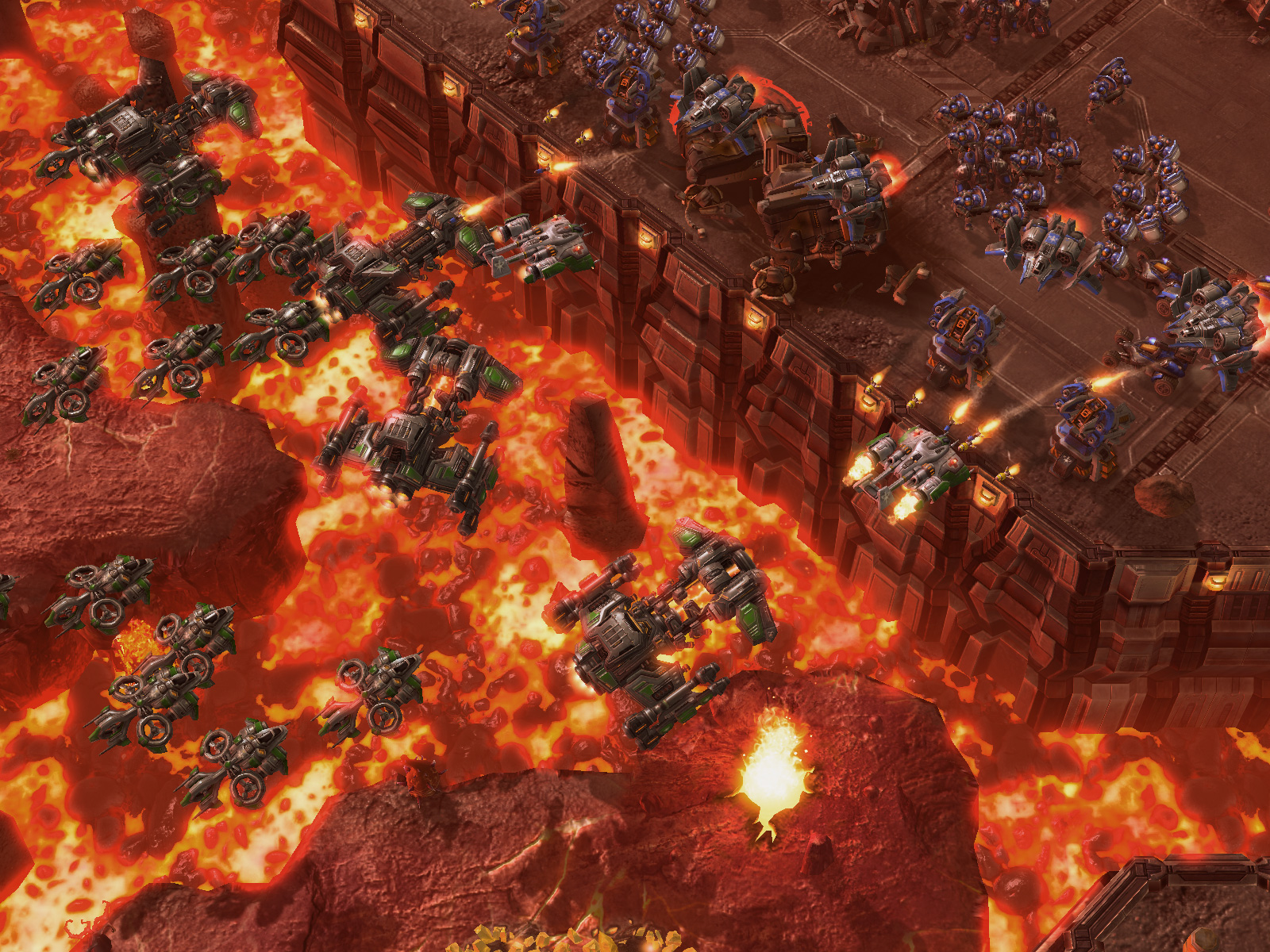
The races of StarCraft II bear plenty of differences, both in unit make-up and strategy. As well, each race requires a tailored counter-strategy, making for a good number of unique matches. Terran units are split into three classes: biological, mech, and air. Trying to build all three may make for a diversified, yet anemic, army. Focusing on two classes is generally advised as many units have supporting roles. The medivac can heal biological units, a popular strategy, and hellions can defend close-range assaults on siege tanks. The reaper, a fun, fast unit, can jump cliffs, perfect for raiding gatherers and sniping undefended buildings. Their use, however, is fairly limited beyond this early-game function. Terran have plenty of variety for experimenting with different army builds. And though I've played with them least, I find that they require the greatest macro of all the races, if only because they require significantly more buildings than the other races.
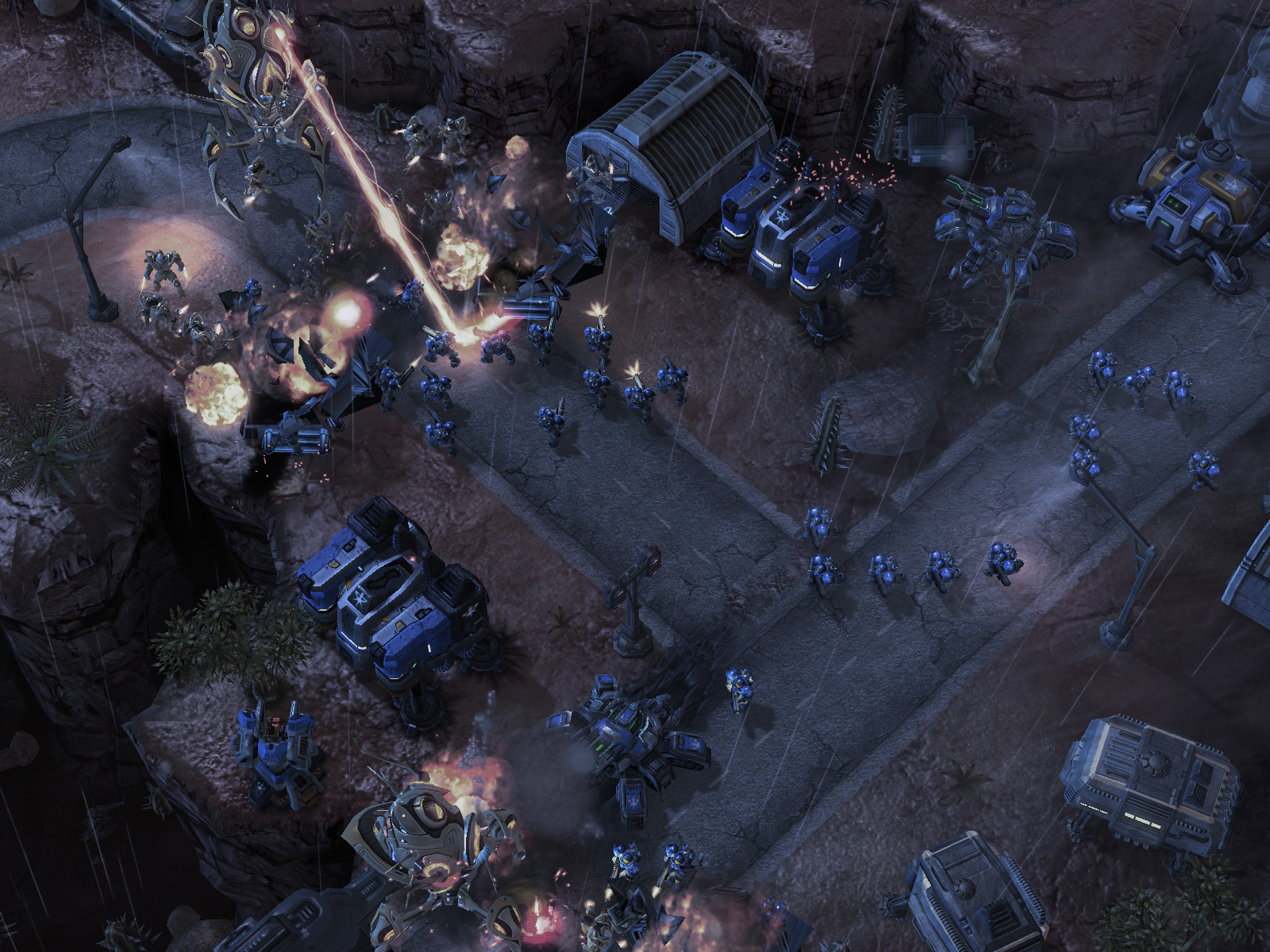
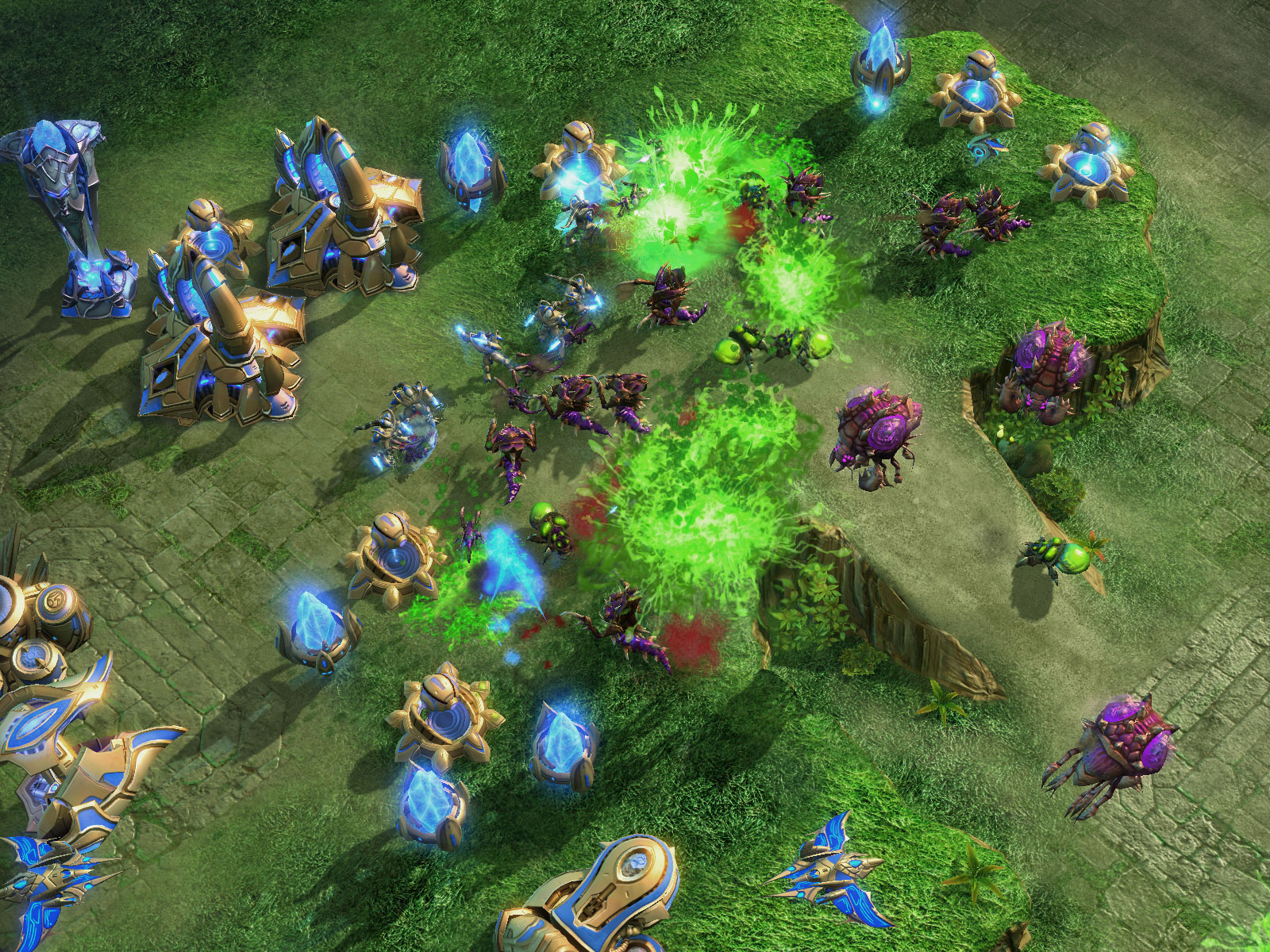
The Zerg are limited early game, particularly because they have no anti-air until tier 2.5, but mid-way through a match, they hit this sweet spot where they can churn out swathes of units extremely quickly. There has been a lot of discussion about the over-simplicity of the Zerg, unfortunately; and I must say that I agree. At least at my skill-level, there is little reason to produce anything but hydralisks. Or if you feel like going air, mutalisks. It is as if the Zerg's innate ability to easily mass units, either actually or perceptually, invites watered-down strategies, since massing one or two unit-types is often a clear path to an overwhelming dominance. That said, satisficing is really no fun. So if you can break the mold of the narrow-minded overmind, you'll find plenty of cool units to play with. The roach, despite its constantly in-flux usefulness, is still an awesome unit. Burrow-sneaking right into enemy bases is a ton of fun when you can pull it off, and its ability to rapidly regenerate health while burrowed is extremely useful. The brood lord is another fantastic unit. Morphed from the air-to-air corrupter, the brood lord exclusively attacks ground with tiny, clawing broodlings. Its range, means of distracting enemy fire, and sheer damage output make it an essential late-game member of any Zerg army.

The Protoss are fascinating to play. Their range of units offer excellent diversity and they have plenty of opportunity for creative strategy. Zealots are excellent throughout a game's duration. Immortals are pure beast; they perfectly counter heavy-fire enemies such as siege tanks. Void rays are unquestionably the most cited unit by the StarCraft II community as being over-powered, but they've been balanced out with a number of patches, and their unique (and effective) attack-style and aesthetics are remarkably enjoyable. The stalker, a tier two ground-to-air unit, in my opinion, is the most useful unit in the entire game. And it can blink past base defenses. The Protoss's first spell-caster is also an integral part of a good army and easily the most accessible spell-caster of any in the game.

StarCraft II is the very definition of an addictive game. Losing inspires me to improve, and winning emboldens further victory. Aside from this, the game is simply fun, lots of fun. There are still plenty of balance issues to be found, but the beta ironed out the most heinous, and Blizzard still has a month and a half before the have to pay the dues. Its sad to see the beta go, but on the bright side, I'll hopefully start being a bit more productive with its absence.

Monday, November 3

WWII General Commander

Today, a game was announced called World War II General Commander -- Operation: Watch on the Rhine. Watch the video from GameTrailers below.


This is an older trailer, but the newer trailer is bland and really quite unexciting. It was developed by Games GI, based out of Madrid, and published by Stragames.

Watch on the Rhine may not be a big-budget or big-production title, but, the game's got some great stuff going for it. The graphics are beautiful, if you ask me. The presentation is that of commanding an army with a strategic board. As you zoom in, it appears, and switch between view modes, the graphics change to show off the available resources, icon views of the battalions under your control, and "detailed 3D models" fighting in realistic environments. The array of graphical styles is impressive enough as it is and reminds me of both Defcon and Supreme Commander.
And then I went to the main website; the game had caught my eye. Reading through the game tutorial, there is some pretty darn impressive strategy going on in this game. Supplies, efficiency (seems to play a large role), terrain advantages and boons, a large variety of unit types, Watch on the Rhine boasts some impressive intricacies beneath its graphics.Basically, I think this game looks awesome and wanted to share it with my readers. World War II General Commander is available for downloading on the 11th, and Watch on the Rhine seems to be just the first in a series of General Commander titles.

Saturday, September 1

Halo Wars: My Opinion

I've done some thinking about Halo Wars since my last post. The question I posed to both myself and you readers was whether Halo Wars should be designed for balance in the tradition of an RTS, or more so in the tradition of Halo itself. I was undecided on the matter. I thought it important for Halo Wars to have balanced play considering its importance in the RTS genre. However, as Halo Wars is also a Halo franchise product, and not just an RTS, it should stay true to the style and feel of Halo, considering its genetics, so to speak. I was deliberating which was more important when it hit me: The answer, A, is that both franchise and genre are equally important, and B, that neither should have to be compromised for the other's sake?Going back to the issue that started this question, the warthog. The warthog in Halo Wars is like an invincible giant compared to the warthog of Halo yore. It does move like a warthog, true, but by no means does it, or its riders, appear to take damage like one would expect. In fact it seems that Halo Wars is merely a superficial skin on what appears to be no more a standardized RTS template. Maybe thats harsh, addmittedly my knowledge of the game is limited and the game itself nowhere near completetion. Therefore everything I say should be understood with these concessions in mind.

The question I keep asking myself is: whay can't Halo Wars be both Halo and RTS? And you say, "Duh! It is. Thats the point." And I totally agree. But not with the game in its current state. I mean why can't Halo Wars really be "Halo" and "Wars?" Their is nothing wrong with the game being an RTS, indeed it makes sense considering the franchise's history. But who ever said Halo Wars has to be built on the same basic RTS blueprints as every other RTS ever made? Noone (except for maybe Microsoft, who knows). My point is, Halo Wars should play like an RTS but feel like Halo.
I love how the warthog moves, and I love that it can jump huge gaps; its an awesome feature. But the warthog should be just as susceptible defensively as it always has been. As things stand now, the warthog is more like a tank, which it isn't. Hypothetically, it could zoom around and shoot at the same time, perhaps automatically, like airplanes do in Supreme Commander. But, really, Ensemble could do absolutely anything, anything they want. But whatever they do I think its necessitous to retain the Halo feel.

My opinions are premature, to be sure, and probably sound a bit more severe in writing than how I actually feel. But who cares? My opinion is moot, really. Yours, however, is not. What do you think?

Also, I should note that the date system in my blog is working incorrectly. This post was actually made on Sunday, September 2nd. And the previous post on September 1st. I've looked through all the settings and there seems to be nothing wrong. There must be something wrong with the code. Bear with me while I figure out what the problem is, thanks.

Monday, August 27

Halo Wars: Staying True

Ensemble Studios, the team behind the Age of Empires series, is working with Microsoft on another RTS based on a completely different franchise: Halo Wars.

Halo Wars is an interesting animal. Halo was originally intended to be an RTS, but in the end became an FPS, as we all know. Now Microsoft is dishing out the original goods with a new RTS based on the Halo franchise. While Halo Wars may seem like a perfect fit for the franchise considering its history, Ensemble is in fact designing one big juggling act.

What is more important: That Halo Wars stays true to Halo, or that Halo Wars is a good RTS. Its an interesting question and not one so readily answered as one might think. Watch the following video, and while doing so, think about this question.


Did you notice anything? What happens to a guy that decides to sit idly in a warthog? He gets sniped, instantly. Heck, warthog drivers get sniped just as often while moving. Such is the nature of Halo. But is it, or rather should it be, the nature of Halo Wars?

The thing about RTSs is that they need to be balanced. The thing about Halo is that people get capped nigh every second. That fact that how ever many covenant can't take out two warthogs, or at least their drivers, is completely absurd. For Halo. But as an RTS, maybe the over-powered warthog isn't so ridiculous afterall. How is it possible for Ensemble to retain the Halo feel in its translation to the RTS genre?I do not have an answer, nor an opinion at the moment. I shall reflect on it a while longer and let you know my thoughts. But what do you think?


On a completely different note: this screenshot from Devil May Cry 4 owns my soul. So does this parody on Rayman Raving Rabbids and Assassin's Creed. Except that it would technically be "Bunny's Creed."

Saturday, April 7

Heroes of Mana Design

Heroes of Mana is a real-time-strategy title for the Nintendo DS. The game is set in the Mana universe but follows an original story. Square-Enix is publishing, naturally, whereas Brownie Brown is the development house. Brownie Brown also developed Magical Starsign for the DS, released last year. Heroes of Mana is arguably the first true RTS for the DS, meaning Brownie Brown had no previous template, so to speak, to work from. Regardless, the game supposedly has a good storyline, and does have very nice graphics, in my opinion. But the true concern is, as always, the gameplay. Fortunately, the team has designed Heroes to play simply and effectively, while still leaving room for strategy.

But first, I need to get some other information out there. Hereos of Mana contains all of the basic RTS necessities: a minimap, fog of war, base building, resource gathering, and of course, combat. Each player can have a maximum of 25 units at a time. Units on different teams are indicated by the color of their health bars above their sprites. Allied units are green, enemy units are pink, neutral are blue.

Units are divided into four types: ground, heavy, flying, missile. Additionally, there are special units and hero units. Brownie Brown has implemented a standard rock-paper-scissors system with the basic four unit types. Each unit type take half damage from another type, and deal double damage to a third. For example, flying units deal double damage to heavy types, but take double damage from missile units. Also, flying units only deal half damage to missle units. This system works throughout all four types. Its an interesting design scheme because some unit types will take eight times as much damage as they are giving. An example is if a flying type is fighting a missile type, the missile type will deal eight times as much damage as the flying is giving back. A balance will be required in building armies. Players will have to see what their enemies are building and counter with the stronger unit type.

On to control. Alright, this is how it works. Heroes of Mana is all touch controlled. Which is a very good thing for a genre designed for the PC. There are a variety of ways to select units. Here is a list of all the control inputs:
  • Tap a single unit to select it
  • The bottom of the screen has four indicators, one for each unit type. Tapping these will select all on-screen units of the designated type.
  • A "select group" icon is off to the right of the screen. Tapping it will allow players to draw on screen and lasso any specific units they want. Then players can command those units as a group, ordering them to travel or attack as needed.
  • A touch screen icon allows the minimap to be switched to the bottom screen for stylus input. As far as I know, units can also be manipulated using the minimap.
  • Heroes of Mana has eight super abilities that can be activated with touch screen icons. These abilites are automatic CG animations and will deal area of effect damage, among other things.
  • Base building is all done within the home base airship, called the nightswan. Buildings will not be physically present on the battlefield.
Speaking conceptually, I think Brownie Brown has created a great RTS for the DS. The game system is very simple compared to other RTSs, which is good for a handheld game that can only handle so much information, graphics, and doesn't have much screen space. However, the combat is still complex enough to allow for strategic gameplay.


Touch Design
What do you like or dislike about the design of Heroes of Mana?
What would you change, if anything? Why?
The rock-paper-scissors scheme, by now, could be considered cliche.
-Is this scheme still a valid methd to balance units?
-What other balancing formats could be used?
The game terrain is 3D, the units meanwhile are 2D sprites.
-Why or why not is this a good design decision for a DS game?

Sources:
Gamespot
1up
IGN

Saturday, March 31

GrimGrimoire: side-scrolling RTS

RTSs have been around for a long time. From WestWood's Dune, to Supreme Commander, the genre has made great strides in its development and complexity. However, the RTS can generally be broken into a "formula" that most all games in the genre adhere to. Leave it to Nippon Ichi then to break the mold. Nippon Ichi Software is the publishermost known for their slew of turn-based tactics games, including Disgea and Phantom Brave. Their games are considered by many to be rather innovative. NIS is now publishing a new RTS called GrimGrimoire for the PS2. The developer behind Grimoire is Vanillaware, which previously developed a game called Odin Sphere. Like the rest of NIS's titles, Grimoire is definitely innovative. Unlike any RTS I've ever heard of, GrimGrimoire is a side-scroller.

In GrimGrimoire, the player becomes Lillet Blan, a magic student at the Tower of the Silver Star magical academy. Five days into classes, the entire school is killed, except for Lillet. She instead falls into comotose, and when she awakens finds herself back at school day one. The goal is to discover the reason for the massacre and prevent it from occuring again. Like all other Nippon Ichi titles, Grimoire features a colorfully animated anime style, in this case, also potentially considered chibi. But what makes Grimoire so cool, is that its side-scrolling, and how the RTS gameplay accomodates for this. Players move around a hand cursor to select and order ghosts. The worry for a side-scrolling RTS, would be to order a bunch of minions over various levels and annoying blockades. However, Grimoire avoids this pitfall by allowing ghosts to pass through walls, floors, and objects. Now, I really like this. The game presents itself with a problem, that of terrain. But Vanillaware subsequently solves the problem in a clever and fitting way, by allowing units to pass through things otherwise considered obstacles.
In related news, apparently Nippon Ichi is now developing for Wii, which means we may soon be controlling GrimGrimoire with the signifcantly more convienient remote.

Strategize
What other techniques would you emply to make an RTS work in a side-scrolling environment?
How do you think the fact that Grimoire is side-scrolling affects the issues of console RTS control, generally tackled with by games including Goblin Commander and Lord of the Rings Battle for Middle Earth II.

Sources:
1up
IGN