Showing posts with label fun. Show all posts

Monday, June 7

StarCraft II Beta Preview

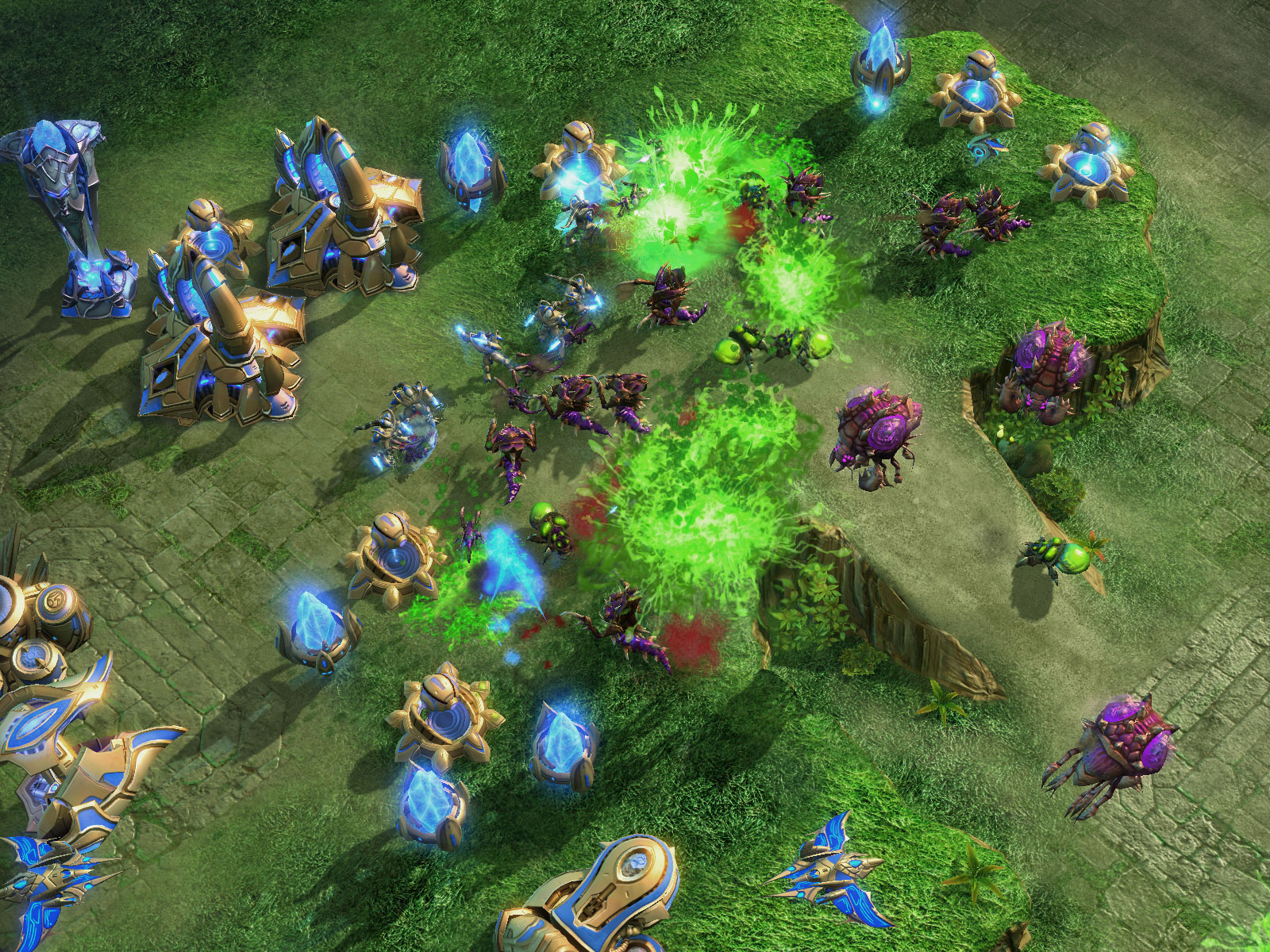
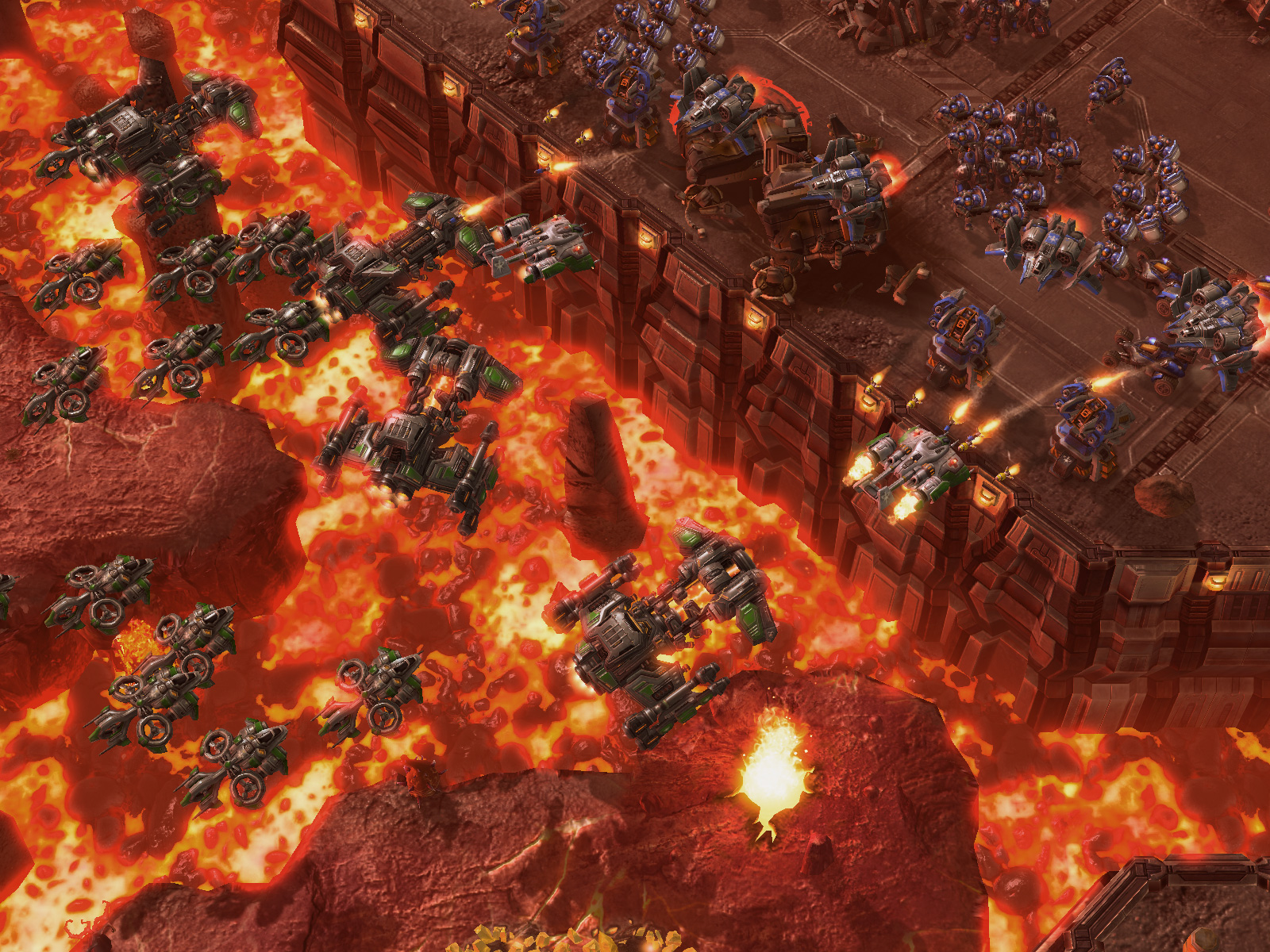
StarCraft II is a dash for superiority. But depending on your skill level, "dash" may be better described as “scramble” or “strategic battle-plan.” Each match is a continual refinement of your game. Each mistake is an opportunity for lesson learned; likewise, each success.

Immediately when a match begins, go! No time to think, no time to blink, only do. The opening build is vital and demands exactness. Workers, more supply, a refinery: over the course of many matches, you will revise and whittle down these first dozen actions into a masterpiece of design. Even then, are you properly rallying your probes? Is your building placement ideal? There are always ways to improve. And all of it towards a specific object, each a milestone on the path to domination. That tiny edge is all you need to win. And you will need it.

Econ, macro, micro, tech, recon: each skill is essential, and your game is only as good as your lowest common denominator. All potential actions must be constantly considered and each given due attention. A finely-microed army will decimate an attack-move five days out of seven, though both this knowledge and the requisite reflexes come with practice. A floundering economy will be unable to fund an adequate army, and a poorly optimized economy will waste good resources that, contrarily, your opponent is likely applying. For recon though, there is no substitute. Scouting is unequivocally the most essential and mandatory skill in StarCraft II. Knowledge is power, as they say, a phrase which StarCraft II more than just practices, it requires.

In a recent match, I had finally decided to attack with Protoss ground-forces, and, quite easily, I demolished my opponent's base with little resistance. But something wasn't right; the base had no buildings other than a couple of pylons and refineries. Shifting my army to a fogged expansion, I realized to my horror that my Protoss opponent had not only early-expanded to a high-yield base, but that he'd also constructed his entire base there. My forces were torn apart by an abominable army, and promptly, I was destroyed. But all of this could have been prevented with a little scouting.

Awareness of your opponent's actions at all times is essential. Barring good scouting, you might win regardless, either by deductive prediction or simply black-mask-blind luck. Let your opponent get the upper hand, though, and you will certainly fail. While you may have a couple of starports reliably constructing banshees, and you're thinking your army is looking pretty good, your opponent may have three hatcheries out there, each with a queen, pumping out dozens of hydralisks every larvae cycle.
Somewhere on the spectrum between plan and reaction, there is a keen balance to be struck. Opening moves should guide you towards an initial or mid-game goal, but you must be willing to adapt to your opponent's strategies, and quickly. Fast-teching to tier three units like colossi or thors may sound like a good idea, but if you don't have the troops to defend yourself and injure your opponent's economy along the way, even a measly enemy force will topple your poor infrastructure.

StarCraft II is a glorious exercise in the learning process. At my skill-level, upper silver ladder, players are focusing on refining their macro, practicing new micro tricks, and just barely testing the waters of magic-casters. Mostly, we're simply massing two or three unit-types and, on occasion, sending forward a scout. Higher level players, meanwhile, are using magic-casters as a core function of their armies, are constantly aware of their opponent's movements and are frequently raiding mineral lines, and are employing more creative strategies, like baneling drops. These things come with experience. But Blizzard, in my opinion, has done an excellent job with their match-making system, and you'll almost always face opponents who are on the cusp of your skill level, just challenging enough without being impossible.

The races of StarCraft II bear plenty of differences, both in unit make-up and strategy. As well, each race requires a tailored counter-strategy, making for a good number of unique matches. Terran units are split into three classes: biological, mech, and air. Trying to build all three may make for a diversified, yet anemic, army. Focusing on two classes is generally advised as many units have supporting roles. The medivac can heal biological units, a popular strategy, and hellions can defend close-range assaults on siege tanks. The reaper, a fun, fast unit, can jump cliffs, perfect for raiding gatherers and sniping undefended buildings. Their use, however, is fairly limited beyond this early-game function. Terran have plenty of variety for experimenting with different army builds. And though I've played with them least, I find that they require the greatest macro of all the races, if only because they require significantly more buildings than the other races.
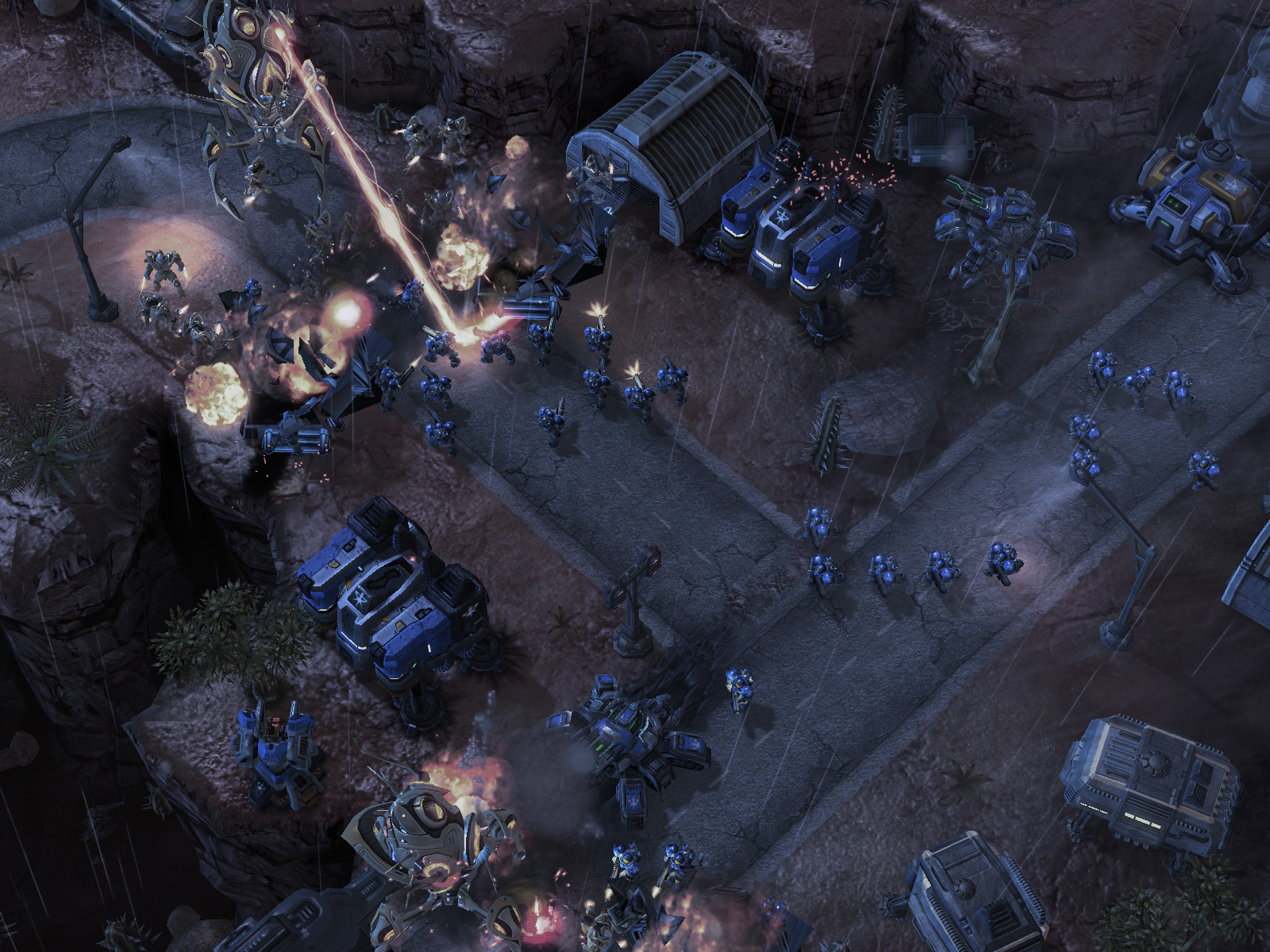
The Zerg are limited early game, particularly because they have no anti-air until tier 2.5, but mid-way through a match, they hit this sweet spot where they can churn out swathes of units extremely quickly. There has been a lot of discussion about the over-simplicity of the Zerg, unfortunately; and I must say that I agree. At least at my skill-level, there is little reason to produce anything but hydralisks. Or if you feel like going air, mutalisks. It is as if the Zerg's innate ability to easily mass units, either actually or perceptually, invites watered-down strategies, since massing one or two unit-types is often a clear path to an overwhelming dominance. That said, satisficing is really no fun. So if you can break the mold of the narrow-minded overmind, you'll find plenty of cool units to play with. The roach, despite its constantly in-flux usefulness, is still an awesome unit. Burrow-sneaking right into enemy bases is a ton of fun when you can pull it off, and its ability to rapidly regenerate health while burrowed is extremely useful. The brood lord is another fantastic unit. Morphed from the air-to-air corrupter, the brood lord exclusively attacks ground with tiny, clawing broodlings. Its range, means of distracting enemy fire, and sheer damage output make it an essential late-game member of any Zerg army.

The Protoss are fascinating to play. Their range of units offer excellent diversity and they have plenty of opportunity for creative strategy. Zealots are excellent throughout a game's duration. Immortals are pure beast; they perfectly counter heavy-fire enemies such as siege tanks. Void rays are unquestionably the most cited unit by the StarCraft II community as being over-powered, but they've been balanced out with a number of patches, and their unique (and effective) attack-style and aesthetics are remarkably enjoyable. The stalker, a tier two ground-to-air unit, in my opinion, is the most useful unit in the entire game. And it can blink past base defenses. The Protoss's first spell-caster is also an integral part of a good army and easily the most accessible spell-caster of any in the game.

StarCraft II is the very definition of an addictive game. Losing inspires me to improve, and winning emboldens further victory. Aside from this, the game is simply fun, lots of fun. There are still plenty of balance issues to be found, but the beta ironed out the most heinous, and Blizzard still has a month and a half before the have to pay the dues. Its sad to see the beta go, but on the bright side, I'll hopefully start being a bit more productive with its absence.

Saturday, December 20

Achievement Unlocked

John, head of game development for Armor Games has created a truly spectacular Flash game: Achievement Unlocked. The game tries to be pointless, but ultimately fails. Or does it? You see, Achievement Unlocked is a fun, addictive game. I beat it twice, almost. So maybe I was wrong. Because the game proves full well that unlocking achievements is addictive as all get out.

Source: Kotaku [via n0wak]

Thursday, November 13

Mirror's Edge 2D!

Mirror's Edge is now in 2D! Or at least in beta. The game comes courtesy of Borne Games, most famous for their flash phenomenon, Fancy Pants Adventure. The project is also described as "a collaboration" between Borne Games and EA, meaning its officially sanctioned. But enough babble; this game freaking rocks. Its just pure fun. And the screenshots can't possibly do the awesomeness justice. The animation is impactful, fluid, and invigorating. Playing this game makes you feel cool. Jumping feels and animates perfectly, particularly when you hit the peak and do this mid-air feet plant and start arcing back down.
The music wasn't working in game for me; maybe its true for everyone, I don't know. But I set the Mirror's Edge Remix album in the background and it jived quite well. Something else: I was half-way through the level before I realized that I was playing Mirror's Edge in third-person. Unfortunately, I haven't had a chance to play DICE's Mirror's Edge yet, seeing as how I'm in Italy. But obviously one of the selling points of the feeling of Mirror's Edge is its first-person view, which I applaud whole-heartedly. But Borne Games has adapted ME's gameplay amazingly well in not only third-person but also 2D. The gameplay reminds me of the original Prince of Persia. One more thing, notice how the art design clearly represents to players what is runnable and what is not. I'll be writing up a more thorough impressions of the game once it releases. Be sure toe let me know what you think of Mirror's Edge 2D in the comments.

Tuesday, August 19

The Worth Game

My brother and I are designing an MMO, called Project Fun. We were talking about the game’s design last night, and, having not discussed the game in a while, we wanted to return to the roots

Last night we were discussing the game’s design, and I wanted to return to the roots of the project: what makes Project Fun fun? Fun is, after all, the entire purpose of this game’s existence. So nailing down this aspect seemed fairly crucial. The problem was I couldn’t answer the question. Why is Project Fun fun? To find the answer, I asked myself a rudimentary question: "what makes most games fun? what makes MMO's fun?" Perhaps seeking some revelatory light, I decided to be a break-down of World of Warcraft, because it is both a game and an MMO, and it's successful.

The fun gameplay of WoW, I discovered, comes from the support of three pillars. These pillars not only share the load of “fun” in WoW, but also the weight and effectiveness of one another. At the most basic level, WoW is fun moment-by-moment. Running, jumping, attacking, managing talents, these are the game's cells. Supporting this pillar is the mission-game. Players are constantly moving towards an objective, a quest, the next level, a raid. The end-game of this pillar is better loot. The third pillar, which reinforces both the other pillars and an overall concept of fun, is the meta-game. WoW's primary meta-game is making your character uber. Another meta-game is your social- and support-role in a guild.

And then what? Hm. Let's recap.

WoW has three pillars, all of which support a goal of fun. You may have noticed that these pillars can actually be attributed to most games. Let’s look at Mario. Moment-game: run and jump/collect coins. Mission-game: collect a star/get to the next level. Meta-game: save the princess/beat the game. The structure is sound. The moment-game is essential. And so is the mission-game. And so is the meta-game. The moment-game provides an immediate stimulus of fun. If the immediate action, be it physical or mental, isn’t fun, then the rest of the game is meaningless. But without an objective, the moment gets old pretty fast. The mission-game provides a challenge or set-piece in which to test the player’s moment-to-moment skills. But then the mission ends. And there to reinforce the structure is the meta-game. You wouldn’t play moment-by-moment without a goal to test your skills against. And you wouldn’t complete the goal without a larger, more meaningful objective. And then I ask: but why complete the meta-game.

I’ll just tell you right now, the answer is fun, which effectively brings the pillars full-circle. The goal of playing is to have fun. And maybe that’s good enough. But maybe not. I don’t really have an issue with the structure. Game design wise, this system makes perfect sense. Assuming each pillar is solid, fun is perfectly balanced. But is that all there is to the system? I lied; I do have an issue. My issue is intention.

I’m speaking specifically about WoW here, because Mario ends. Blizzard has perfectly honed this system. Call it science; call it math; call it whatever you want. I call it crack. WoW’s pillar system is built with a bait mentality. It is a carrot and stick reward system. Let me break it down: get quest, run to quest, kill mobs, loot mobs, return to quest-giver, receive loot, gain level, get new quest. Blizzard isn’t lying about anything. Your character is getting better. But as a person, you are getting worse. At first, the addiction might be fun. The pillars are indeed solid. It’s a new experience in an exciting world. But pretty soon, WoW becomes a reward grind. But are you still having fun? Doing the same things you did at level 1, are you still having fun? Or is it just an illusion? Addictions mentally and chemically make us believe we enjoy something. But at what point did the addiction stop contributing to our lives? At what point did the game become less so fun, and more so necessity.

I do need to make a disclaimer. There are many out there who do learn and grow from WoW. Specifically, those who nurture relationships in-game, who learn from others, who become better people through their social interactions are benefitting from WoW. But they have escaped the addiction. To them, the game is no longer about getting more loot. They are taking advantage of WoW’s other attributes to grow as people, not as avatars. Another example, WoW can teach players how to work together. Teamwork, leadership, sacrifice, some players learn these skills from playing WoW. But again, for them the loot becomes secondary, a perk, they enjoy WoW as an outlet for social expression. I also think of the Penny-Arcade guys; I know for a fact that they are too smart to become addicted to a system. They derive some other, more valuable, meaning from the game.

I am making a very large assumption. That WoW’s pillar system was designed to be addictive to players. The present MMO structure is what’s really at fault. The game and company thrives from long-term play. So designing a system that promotes long-term play is essential to the game’s success.

My issue with all of this is intention. What is the game intended to do for players? A better question: what is the game intended to do for people? What is the game’s purpose? Why does it exist? How does it benefit a person’s life? I cannot answer these for WoW, though I can make guesses. The most obvious is fun. Or, how about relaxation after a long day at work, or vegging out, or escaping the torture of homework? Intention. What is your game intended to do? If WoW’s answer is fun, does it succeed? The answer to that, however, is not intention, it is affect.

Affect is what people gain from the game? Regardless of intentions, what do people get from playing? WoW might act as a stabilizer. Maybe the pillars of fun are something solid for people to lean against. Maybe WoW is something people can rely on for support and comfort in a difficult life. It’s always there. It’s easy to do. It gets your mind off of the craziness of day-to-day life. This is great until it becomes a crutch. Also known as an addiction. Where players cannot function without it. Where the game becomes necessary to wake up in the morning and go to sleep at night. And then what are people learning from the game?

And now the question isn’t about fun at all. The question is, what is the purpose of this game. I asked my brother that very question last night. “Fletcher, what is the purpose of Project Fun?” He answered, “fun.” And I asked, “Why fun?” He responded, “Why life?”

The great Carl once said, “Why does anyone do anything?” This question is the meaning of life. The answer is to grow as people. To learn. To develop. Our goal is to change. Not to change negatively, and not to remain static, addicted to something that stopped giving long ago. We need to ask, “what is our purpose?” If the answer is to design games, then the designing of those games should help us grow as individuals, and our creations should help others grow as individuals too. It’s the golden rule.

The question is, what is the purpose of my game? What is the worth-game? The answer might be fun. The answer might be to provide relief from stress to individuals. But we need to seek a higher purpose. We need to find something deeper than a take-twice-daily dosage of stress-relief.

In his book Jonathon Livingston Seagull, Richard Bach writes, “There’s so much more to flying than just flapping around from place to place!” Game should be fun. I mean heck, I love fun. But games can offer so much more than fun for the sake of fun. Games can offer experiences that help us grow. Mentally, physically, emotionally, spiritually, games can take us places that we didn’t expect, to universes we didn’t know existed, but can be fun while doing it.

Saturday, February 2

By Force or Design?

I got a call from my brother the other day. He said he'd recently spent alot of time playing the Burnout Paradise demo. He said, "Finn, did you know you can't restart races." I replied that I was aware of the fact. For those who don't know, Burnout Paradise is a free-roaming driving game by Criterion. Players can drive anywhere in paradise city and do as they please. The racing structure is found at intersections, where players can initiate various racing events. Speaking on the phone with my brother, he explained that once you begin a race, you can only restart it by returning to the starting-line intersection. It should also be pointed out that players are not locked into any event that they begin. If players see something that interests them while racing, they are free to just drive away from the event and consequently drop-out, albeit willingly.

My brother took issue with this, what he called, "restriction." He asked me, "Is it ok for a game to force you to do something? Is it right to force players to play a certain way." He had a valid point. Burnout Paradise has a very specific and intentional design. Every aspect (or not) of the game is intended to support the overall open-world design. Criterion really wants players to play Burnout Paradise in a certain way. But I mean this is a good way; I think the notion is admirable, in fact. You see, Burnout Paradise is not a traditional racing game, its a sandbox game. What Criterion is really doing is asking players to let go of their expectations. You are not playing Need for Speed, you're not playing Project Gotham, you're not even playing Burnout, at least not in its earlier incarnations. Burnout Paradise is a beast all to its own. Criterion is asking players to accept a new type of game before even picking up the controller. They're asking you to dash your expectations for what a racing game is and play Burnout Paradise for what itself offers.Now, this sandbox type game has actually been done before, in a few ways. Need for Speed: Most Wanted, Midnight Club, and what I think most closely resembles Pardise, Rush 2. But Burnout Paradise arrives with a new generation of consoles and gamers, and more importantly, it really is different from all of the above.

The non-restart system is indicative of the entire game's design. Burnout Paradise has non-linear gameplay. The races themselves are mostly non-linear and the open-world is certainly non-linear. However, by not allowing players to restart a race, Criterion is literally forcing players to play a certain way. Now here is the real quesion: Is it ok to force players to do something just because you want them to play a certain way? Is it ok to restrict their playstyle?
I would argue, yes. This is what we do as game designers. We request players to assume specific playstyles all the time. You want to restart the race? Too fricken' bad. Adapt. Criterion is asking alot of players, and at the same time, they're really not asking much. Burnout Paradise wants you to have an open-mind. If you approach the game with certain expectations, like being able to restart, you will inevitably dislike the game. This is what my brother told me, "It is impossible to enjoy Burnout Paradise immediately, you have to play for at least three hours to finally realize the game's fun."

Ah! There it is! Criterion is saying "We want you to have fun. Trust us. Just give us a couple of hours and you will learn how to have fun within our world." So, is it right to force players to play a certain way? Heck yes. You need to have confidence in the fun in your game. You also need to ease them into your new playstyle, but thats a different matter altogether. Burnout Paradise is all about having fun in the moment. Fun is all around you, just explore a bit and you will find it. You won't be so disappointed about losing a race and not being able to restart because their is more fun to be had right in front of your eyes. In a way the game is even catering to our ADD generation.A final question: Would Burnout Paradise be more fun if it allowed you to restart races? Would the option detract from overall design? I think it would. I can gurantee that if players had the option to restart a race, 99% of the time they would. And then what? And then the game wouldn't be what it is. It would lose its open-world effect, and devolve into something more like a hub-world for a bunch of races. And thats no fun.

Burnout Paradise is innovative. In writing this rather rantesque article, I've come up with a definition of innovative game design. Innovative is asking players to let go of their expectations for what a game is. Innovative is breaking lose from the status-quo to becoming something different, something more than just convention. Innovative is saying, "We're not going to let things like genres decide what our game is going to be. We're not going to give in to give in to a predetermined definition of fun. We know what fun is. We're going to make that fun and give the players something they don't even know they want yet. That is innovative."

Saturday, September 8

Shadow Monsters

Shadows are very, very near and dear to my heart. Thats why this concept is so cool. Its called Shadow Monsters. The hand shadows are actually being changed via the projector. The system was designed by Worthers' Original.

What is really interesting, is as I was watching it I began to look for consistency. Its quite possible you did so as well. You can actually see diagrams of the projectors functions in the background of the main website. I think its funny I looked for its inner workings so quickly. A big issue in video games as of late is the consistency of a players' input. In particular, this is mentioned for Wii and PS3 motion control quite frequently. When analyzing the video, I was looking for consistency. "Ok, how do I make an eye, how do I make teeth?" Why valid questions, I soon realized I was looking at the game the wrong way. It doesn't matter how specific images or sounds are generated. Thats not the purpose of the game. The purpose of the game is to have fun creating awesome-crazy looking monsters that bark and wail at each other. And laughing. I'm sure the projector does determine these effects somehow. But its besides the point. The game really just wants you to have fun playing around with shadow puppets and watching them morph and interacting with the changes. Its awesome.

Kotaku
Shadow Monsters

Friday, August 24

Play Motivation

IGN tipped me off to a survey the University of Amsterdam is conducting entitled "Motiviations for Playing Video Games." The survery takes about 15 minutes and is well worth your time. What is most interesting about the survey is how you're forced to question your own motivations for playing. This isn't a simple Q&A, its a search into your soul: Why do you play video games. The most fascinating question, to me, was this:

"While I am playing the video game, I think about how much I enjoy it."

Do you? Answers are guaranteed to be different for different people. Think about this for awhile and then get back to me. I want to know what you guys have to say. After you've come to some sort of conclusion, think about the same question from a designer's perspective. Do you want players to think about having fin while playing a video game? If so, then how do you go about designing a game to achieve this?

Take the Survey
Picture Source

Also, IGN has a great interview with Demiurge Software's director of development about Brothers in Arms: Double Time for Wii. He basically talks about the importance of desiging to a system. Valuable information indeed.