When Michelangelo sculpted
The Pieta, he chose to make the figure of Mary larger than that of Jesus. This decision by Michelangelo was that of a specific presentation. Michelangelo is showing Mary as prominent over Jesus, literally, through her size. This unique presentation of a classic Biblical relationship leads admirers to reflect upon The Pieta's meaning and the significance of Michelangelo's decision.

Game design encompasses the same issues of presentation and meaning. Like sculpture, painting, or music, game design is an art open to possibilities and options. Presentation is one aspect of design that is increasingly paramount in importance, and only limited by designers' imagination in terms of all the forms it can assume. As with all aspects of game design, a game's presentation must be designed in cooperation, or along with, the remainder of its elements. While there are countless ways of presenting information to players, the zeitgeist of gaming is shifting towards a more seamless approach. This shift reflects the western gaming culture's expectations of next-generation gameplay. Seamless presentation, as opposed to other approaches, is unique in its pursuit of an ideal immersive gameplay. These terms are synonymous; the choice to present a game seamlessly is the desire to create a highly immersive gameplay experience. Seamless presentation is by no means the be all, end all, of game presentation, but it is certainly a viable approach that is rapidly becoming more and more popular in the design community.
But what exactly are designers looking to present anyway? The answer is everything. For truly, presentation is a continuum. For the purpose of discussion, though, I've divided presentation as a whole into three parts: information, theme and story, and interaction. I will briefly discuss each of these points individually, then expound upon these basic explanations with specific examples from modern video games. As rivulets flow together to form rivers, once these three elements are presented in a similar seamless manner, they mesh and cooperate with one another to create a whole, immersive gameplay experience.

Players need information to play a game. The style of presentation is the form in which any given information is fed. The most common form of information conveyance is the HUD, or heads-up-display. Generally, the HUD includes things like resource statistics, the ammo of a firearm, or the health of a character. And even simple information like these can be presented in varying forms. Take for example a vehicle's speed in a racing game. Designers can choose to feed this knowledge to players with a speedometer, or through a more simple numerical count.
But rudimentary information is not all that needs presenting to players. We all know games are more than just lives and top scores. Games evoke emotion. They have stories and plot lines and themes. Games have characters, landscapes, and environments. All of this must be presented to players. The original format for story presentation was the text-scroll. “All your base are belong to us” was as effective as it got back then. But technology has improved. And with it, game design. Since the days of text-scrolls, the continuous arrival of superior technology has inspired new opportunities for different kinds of presentation. The next-gen systems offer previously impossible or unavailable possibilities. Seamless presentation is profiting the most from these advancements.
The last area of presentation is interaction, which many would likely argue is the largest contributory element to gameplay. The presentation of interaction refers to how, or in what ways, players effect, manipulate, or respond to a game through control. Video games have always been about interaction. But just like other aspects of the medium, interaction can be presented in various ways. As we delve deeper into the next-generation of video games, a more immersive seamless approach to interaction is beginning to take hold.

The HUD or user-interface has been around since games were invented, but video games are increasingly presenting this very same information in a more seamless manner. One example is Lionhead Studios'
Fable 2. The game is yet to be released, but already it is apparent that most everything the RPG has to offer will be presented with immersive gameplay in mind. This presentation includes seemingly basic information like player location and navigation. In
Fable 2, players assume the role of young boy during his growth into hero or villain. During the game, players are accompanied by a pet dog to train, play, and fight with. The dog is more than just some superficial addition; governed by complex artificial-intelligence, dog and player can complete realistic and intelligent interactions. In his 2007 Game Developer's Conference presentation, Peter Molyneuax, head of Lionhead Studios and lead designer of
Fable 2, demonstrates and discusses the dog as a functional aspect of gameplay.
“We ask what is his job here. What sort of gameplay can we get out of this dog? His job at this stage, he stays in front of me. That's very important. Quite often with co-op characters in games they stay to the side of you, or behind you. He's in front, he's scouting, he's looking for treasure, he's looking for new things. That's very important.”
“You'll notice that something is missing in this [television] screen. And what is it? It is, it used to be here [pointing to the top-right of the game screen], the mini-map. God I hate that thing. I hate the fact that in
Fable 1, you could play the whole of
Fable 1 with the mini-map. The millions of pounds and hundreds of hours of work that we put in the world were worth nothing cause you were playing the whole thing on the mini-map. Can we get rid of that mini-map? Can't he be your guide [pointing at the dog]? When you come to a junction like this can he point you down there? Now he's not a complete solution, but he's a partial solution.”
The mini-map is a standard piece of game presentation. It shows players their relative position, their surroundings, and usually their destination as well. And it serves these purposes nicely. But as Molyneuax suggests, the mini-map is so convenient, it actually interferes with a players' immersion in the game world. The dog in
Fable 2 achieves the same purposes as the mini-map, but presents them in a much more seamless fashion. Instead of a mini-map showing a bird's-eye view of nearby paths, the dog will run ahead of players and actually trace the paths out and, to the best of the AI's knowledge, dynamically lead players to their destinations. Moreover, the dog, being a dog, has heightened senses and will recognize the presence of nearby enemies, and as any good hunting dog would, will bark and alert players to their presence. This is contrasted with red dots representing enemies on a circle in the corner of the screen. The dog is just one example of
Fable 2's seamless presentation. The dog immerses players in their surroundings through player-interaction and the emulation of a real-life creature. At the same time, the dog is seamlessly presenting to players vital gameplay information with its behavior.
A second game offering seamless presentation of information is Valve's soon to be released
Team Fortress 2, an online-multiplayer first-person-shooter.
Team Fortress 2 is all about class-based team competition; players join opposing teams to fight as any of nine different character classes. Each class plays differently, possessing several inherent strengths and weakness that deign them either prone or resilient to other character types. Therefore, it is essential that players immediately acknowledge who are their allies and also who are their enemies.
Team Fortress 2 is a fast paced game, players need to process player-class identity quickly to tactically adapt to any situation. To achieve this end, Valve employed a unique, pervading art direction which was fully-integrated with gameplay. In an “illustrative rendering” video featurette, a Valve team-member discusses the art design of
Team Fortress 2:
“Through very intentional art direction, this goal was supported by designing characters with distinct silhouettes that can be easily identified even with no lighting cues. The body proportions, weapons, and silhouette lines were explicitly designed to give each character a unique silhouette. In the shaded interior areas of the characters, the clothing folds were designed to echo silhouette shapes in order to emphasize the silhouettes as observed in the commercial illustrations which inspired our designs.”

The individual character models are directly incorporated into the game world and gameplay, making for a seamless presentation of meaningful information. This art direction is not limited to characters alone but is indeed applied to the game's entirety, including an allowance for quick discrimination of team color and map location:
“For the architectural elements of the world associated with each of the two teams, we defined specific contrasting properties. While the red teams architecture tends to use warm colors, wooden materials, and angular geometry, the blue teams buildings are composed of cool colors, industrial materials, and orthogonal forms.”


By designing gameplay around a united art direction, Valve is immersing players more fully into
Team Fortress 2. Valve's greatest achievement is their integration of gameplay with visuals. Every aspect of the game works in concert to both immerse players and give them the information they need to play well.
As we discussed before, information is only one area of game presentation. Our second type is equally important: theme and story. An excellent example of this is
Shadow of the Colossus, an action-adventure title designed by Fumito Ueda and developed by Sony's SCEI studio.
Shadow of the Colossus is about self-discovery, and more importantly, is about self-discovery through gameplay. Several themes are presented to the player via seamless means; among these are solitude and compunction.
In
Shadow of the Colossus players become a man known only as “Wander.” The player's only mission is to resurrect a girl named Mono. To complete his quest, Wander must destroy sixteen different colossi, gigantic living stone creatures. With the help of a horse named Agro, players explore and traverse an expansive world to individually locate and defeat each beast.

In their search, players are meant to feel alone, isolated. In addition to the main character's name, Ueda presents this isolated feeling in a few ways; all of which are very simple but highly effective. In all of the game world there are only two characters aside from Wander and Agro. This in itself makes for a feeling of loneliness, being unable to interact with other people. A second effect is the size and desolation of the game landscape. Wander is dwarfed not only by the colossi but by the environments as well. The environment is constructed largely of big rock cliffs and deep, long valleys, presenting to players a sense of barrenness and emptiness. The third technique is silence; there is never music playing while Wander and Argo are traveling the land. Only the sounds of hoof beats and wind are emitted. These elements of desolation are naturally integrated into the world, seamlessly presenting a feeling of isolation to players.
Another game that has fantastic presentation of story and theme is Irrational Games' (now known as 2K Boston) recently released
BioShock.
BioShock takes place in desecrated underwater city called Rapture. What was intended to be a paradise has been destroyed by greed and madness. During their exploration of Rapture players must find a way to survive while searching for the reason behind the city's fall.

Players are wholly immersed in the world of
BioShock. Visually, aurally, and interactively, players experience Rapture as if it were real. The story is presented to players primarily through audio-clips, being one of the most advanced pieces of technology available to Rapture. These audio logs were recorded by individuals of Rapture and are strewn throughout the game world, waiting to be discovered on desktops, dead-bodies, and enemies. Players are able to play each tape they find and as they do so learn more and more about Rapture's history. The varying denizens of Rapture offer differing accounts and perspectives of the city, allowing players to formulate their own opinions. This piece of story presentation is both functional and natural, immersing players in the game world while at the same time conveying necessary and interesting information about it.
As players explore Rapture they discover the primary theme of
BioShock: no place is perfect for everyone, there is no eden for all. Players realize this theme through personal experience simply by walking through Rapture . Rapture is falling apart, ethically societally, and literally. Rapture was built to last forever, underwater and separated from other imposing societies. But in the cities negligence and metaphorical implosion, the beauty that was has been all but destroyed. Statues of grandeur once lining the walls are now nothing more than heaps of broken stone. Paintings are torn, wood is splintered and burning, the entire city feels forsaken. Even worse, the walls are leaking. No matter how well contained they build Rapture there will always be leaks.

The world of Rapture and this play experience serves to reflect the game's themes. Levine and the team at Irrational Games are presenting to players a world of moral corruption by allowing them to directly and representationally experience the effects of Rapture's greed.
BioShock immerses players in Rapture with immaculate graphics and sound effects, seamlessly presenting players the story of Rapture and the themes and messages meant to be taken away.
The final point of seamless presentation is interaction. One title that has become very popular this past year exemplifies seamless interaction quite well:
Wii Sports. Nintendo's Wii was specifically designed to be highly interactive and
Wii Sports takes advantage of this goal quite well.
Wii Sports is actually five games in one, featuring simulations of sports titles tennis, golf, boxing, bowling, and baseball. While some of these simulations are more successful than others, they all were designed with the same principle in mind: immersive interaction. With
Wii Sports, Nintendo is presenting an alternative to analog sticks and buttons; they are presenting interaction that is more involving and in effect more seamless in its emulation of real-life activities.

In the tennis side of
Wii Sports players swing the Wii remote as if it were an actual tennis racket, and similarly in baseball mode, swing the controller like they would a bat. In golf, players tee-off and putt as if holding a club. The remote becomes a virtual ball in bowling. And in boxing players grip and punch the nun-chuck and remote like they are truly throwing hooks.

Naturally, each of these games require different input methods or swings to play. But Nintendo designed the game to be simple renditions of each sport. Nintendo chose to present the games such that players can intuitively grasp the means of interaction. A controller pad as an interface does little to imitate playing tennis; swinging a remote, however, is physically fairly close to actually swinging a racket. By closely emulating reality, and requiring more active input on part of players,
Wii Sports avoids the seams of button configurations and instead allows players to become immersed in their gameplay experience.
My final example of seamless presentation, and of seamless interaction, is
Okami.
Okami was released this time last year and developed by now disbanded Clover games. Players of
Okami become sun goddess Okami Amaterasu in the form of a white wolf. The fantasy world of
Okami has been invaded by a demon named Orochi and infested with a dark substance, polluting the land in a purple haze. Like
Team Fortress 2,
Okami was designed with very distinct, pervasive art direction inspired by the sumi-e painting style. The world's landscape is like a painting of its own, formed of large brush strokes and colored with pastels. Amaterasu exists in a living painting. Though this is cool in itself, the amazing thing about
Okami's art style is how it crosses the gap from being purely aesthetic to wholly interactive.

As Amaterasu, players possess whats called a celestial brush that allows them to interact with and directly effect the game world. By holding R1 the screen becomes a canvas for painting. Manipulating the face buttons and analog stick, players are able to maneuver a paint brush and interface with the canvas as they please. Brush strokes from a finished canvas are transposed into the game, assuming form, shape, and function. Painting a line through the ground, for example, will create a stream of flowers, while painting a dot will plant a seed that quickly sprouts into a tree. Throughout the game, players learn new brush techniques which allow for new and helpful interactions. Painting a circle in water will create a large lily pad for Amaterasu to stand on; painting a spiral will create wind that blows out fire; and filling in the broken gap of a bridge will repair the damage.

Clover has synergized art-style with interaction. The celestial brush not only matches this feeling but is integral to gameplay, allowing players to naturally transform their painted world as needed.
Okami is not special in allowing players to interact with the world, but rather is so for its presentation, the style by which players interact. The immersion as a player is derived from painting on a world that looks and feels just like a painting.
Okami allows players to interact with the game seamlessly, using a paint brush as a means to affect a painted landscape.
Presentation is the form in which information is appropriated to players. Seamlessly presenting information is to do so in an immersive manner, allowing players to feel more absorbed within the game. I could go on about the dialogue system of
Mass Effect, or the free-running or
Assassin's Creed, or the minimalistic style of
Defcon; but if we simply open our eyes we will see more clearly how many games involve players more completely and bring about a rich, enthralling gameplay experience for them. By seamlessly presenting information, story and theme, and interaction, we can immerse players more fully into our games and come that much closer to meeting, even exceeding, our definition of next-gen gameplay.
Image SourcesThe PietaGRAW 2Team Fortress 2 CharactersTeam Fortress 2OkamiFable 2BioshockWii Sports

 Raph Koster recently did a presentation at GDC Prime in San Diego. Along with his speech were numerous slides, 101 to be exact. Thankfully, Raph's a nice guy and edited the slides to include some of the audio comments he made during the actual speech. Whats more is that the slide presentation is totally awesome. Its about the new media world we're living in today. Koster says some fairly eye-opening stuff. Or at the very least its enjoyable to simply progress through the slides and realize its meaning while pondering its importance.
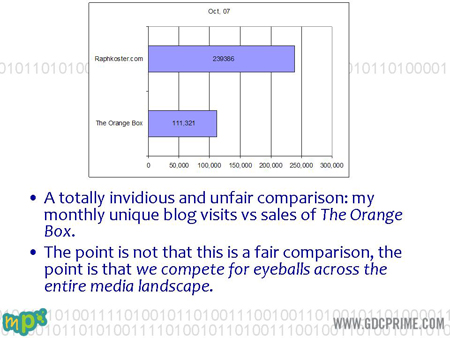 I think he's right, really (and maybe you do too if you're one of his multi-thousand visitors). Games are quickly becoming much, much bigger than the small box in which we strive to define them. Facebook applications, for example. What I get out of this is . . . this: We need to start broadening our perspectives to account for multiple forms of media and game design. Nobody's telling you to disregard Halo 3 as a video game, let alone that it is a good, successful, or exemplary video game. Halo 3 is anything but insignificant. But just because Halo 3 is important to you, and me, and many, many others, doesn't mean facebook applications can't have their place as video games or media, too. Games aren't so mainstream anymore, and thats a good thing; we just have to embrace the changing face of video games.




 Posts


