Hey everyone! Long time, no see. I'm working on graduating this May and, somewhat unfortunately, have chosen to devote my time to things other than writing articles. That is not to say, however, that I've forgone my game playing, research and design. I am now the proud owner of a PlayStation 3 and am every so slowly working my way through Grand Theft Auto IV (finally). I've also been playing through Burnout Paradise, Flower, and MadWorld, not to mention keeping up with Super Smash Bros. Brawl. I'm making some pretty intensive analyses of above games and, in the not to distant future, will have posts here discussing them. I'm also working on a two very interesting discussions of Team Ico's Shadow of the Colossus. On top of playing video games, I am a firm believer in research of video games and game design theory. Naturally, I extensively read articles all over the Internet, but I am also quite enjoying Jesse Schell's The Art of Game Design: A Book of Lenses, lots of wisdom.
That's my update on life. But I want to talk for a brief period about Dead Space and its upcoming Wii incarnation, Extraction. Check out the trailer:
EA is aiming to label Dead Space: Extraction a "guided first person experience." And though the game is essentially an on-rails shooter, I think EA has a right to posit their games as they please. Anyone seeking to innovate, in whatever manner, deserves gold stars in my book. And, based on what we know, I think they are attempting improvements to the genre. The on-rails shooter has a meaty history, including Time Crisis and House of the Dead. I also think many would agree with me that Killer 7 is an on-rails shooter, and an excellent one at that. Wii particularly has received much favor from the light-gun genre. Resident Evil: The Umbrella Chronicles was designed specifically for Wii, but games like Rayman Raving Rabbids, Call of Duty: World at War, and Medal of Honor: Heroes 2 feature specific light-gun modes. While these all may be fine and good, it's starting to get a little out of hand , actually. So when yet another on-rails shooter is announced for Wii, it's easy to say "pshaw" and move on with life (with full motion, zing!), Extraction bears a particularly interesting design.
My initial reaction to Dead Space: Extraction was "lame." I'd basically decided that the genre was of diminishing value and that Extraction was likely a cash-in on Wi''s 50 million units. I've since changed my mind, however. And here's why: Dead Space is perfectly suited to on-rails gameplay. Even more specifically, Dead Space is perfectly suited to on-rails gameplay on Wii.
I've played Dead Space, or rather, the first four chapters on hard mode (before my friend returned it to GameFly; I intend to purchase and finish it this summer). My friends and I actually had a blast playing the game. It is highly polished, quite beautiful, and fun. We would watch each other play, with much back-seat gaming, and weigh the pros and cons of the various weapons and upgrade paths. I do not believe the game was particularly scary, except for the fear of dying and having to restart. Fear and vulnerability is something I've been thinking about a bit and will introduce in another post. But Dead Space is an enjoyable game, and at the least very interesting, and is making a marked transition to Wii.
My cause for reconsideration of Dead Space: Extraction was two-fold: the plasma cutter and the value of movement.
The default gun of Dead Space is the plasma cutter. Because of the limb-dismemberment focus in Dead Space, the plasma cutter is truly the ideal weapon for facing the game's necromorphs. The plasma cutter fires a short line of plasma, the rotation of which can be adjusted with the alternate-fire button to be horizontal or vertical. Skillful employment of the plasma cutter comes down to manipulating the reticule's rotation and, obviously, aiming effectively. Do you see where I'm going with this? In Dead Space: Extraction, rotating or tilting the remote on its side rotates the plasma cutter vertically, as well as serves as the alternate-fire button for every other weapon. There is something extremely tactile about this mirroring of in-game action with real-world control. It's amazing how such a minor change can have such a massively-damaging impact. Expounding the implementation of this control in Extraction is the other key element to fighting: aiming. Aiming via Wii's sensor-bar has proven to be quite effective thus far, and Dead Space: Extraction is likely to follow suit.
This adaptation of control got me to thinking about other potentialities about Extraction, which ultimately led me to an interesting thought: the value of movement. Dead Space is a third-person shooter and, unlike on-rails shooters, allows for full range of movement in the world. As Isaac, players are free to go where they please within the levels. Additionally, unlike Resident Evil 4 and 5, Isaac can move, albeit slowly, while aiming and firing. Let's examine a few basic reasons players move in the game:
1. To advance in the levels.
2. To pick up items.
3. To maneuver around necromorphs.
Obviously, advancing is an important goal, one achieved via movement. Picking up items may seem trivial but, while playing the game, I found it to be a pointed aspect. Finally, and most importantly, tactically maneuvering around, and often fleeing from, necromorphs is essential to winning battles. There is a fourth reason for movement: exploring the game. The game's setting, the space craft the USG Ishimura, is a beautiful creation. Exploring and taking time to note its craftsmanship is fun in its own right. Therefore, I would indeed say that movement is, in fact, of value in Dead Space. Its omission would likely be a mistake.
However, given these aspects of the game, exploration, puzzle solving, etc., in terms of challenge, Dead Space boils down to a serious of fights with necromorphs. And of the necromorphs, there are only a few, (slight spoilers perhaps) the standard zombies, the babies, the gorillas, the bat-stomachs, and a couple others. Zombies mob Isaac from all angles, and running to a more optimal firing position, so that the zombies group together, is vital. Gorillas need to be dodged, generally with the help of stasis, and backed-around to hit their exposed butts (line gun ftw). The difficulty of these enemies drastically changes with chosen difficulty setting. To kill a basic zombie, the number of shots to the limbs doubles between medium and hard. The need for maneuvering and/or fleeing the enemy, therefore, scales with difficulty. Even so, aside from the aforementioned, killing necromorphs by and large requires little movement. Aim, flip the reticule, and shoot.
I do not think this is bad. And, again, maneuvering around enemies is an important part of gameplay. But most of the player's time in combat will be spent shooting, standing still, not running around. This is to the game's benefit. With the camera, and with the the transition between aiming (bringing up your weapon) and moving (putting down the weapon), switching between the two too often would be tiring. I'm not saying that Dead Space is exclusively aiming and shooting, I'm saying that aiming and shooting is what Dead Space does best, and what it primarily features.
Dead Space: Extraction, though potentially perceived as a nerfed rendition of its big brother, is designed specifically to Wii. Wii has less power than the other consoles, it's fact; Dead Space in its original form could not run on Wii. So necessity calls for change, either in the form of significantly reduced polygons and enemies, or, better, via a complete overhaul. Dead Space: Extraction removes free movement (though it will reportedly allow for branching paths). We don't know enough yet to say whether players advance forward automatically point-to-point or move gradually on a line, ala Killer 7, but the limited movement will work well, I believe.
"Strategic Dismemberment" was a tag line for Dead Space, and rightly so, because it is certainly a high-point of gameplay. What EA is doing with Extraction, under the limitations of a less-powerful system, is to highlight the qualities of Dead Space and not offer movement for movement's sake. The phrase "a guided first person experience" is apt. Extraction looks to do offer all of the original's best aspects, and just maybe, improve upon them. From first-person, yes, with limited movement, yes, but Extraction retains what matters most: the challenge of properly dismembering limbs.
As I said before, light gun games are a proven genre; they're fun. Dead Space works so blatantly well as a light gun game, it's amazing nobody thought of it sooner. Dismembering limbs is the new head-shot. And within the confines of the genre, lack of movement loses nothing; indeed, controlled play, limitation of movement and options, may enhance the game. It's like tree sap. 97% of sap is water. By boiling down the sap, we are able to procure the sweetest 3%, the wondrous maple syrup.
Showing posts with label dead space. Show all posts
Showing posts with label dead space. Show all posts
Monday, March 30

Thursday, October 30
Development of Presentation in Paintings of the Last Supper
I'm taking a Renaissance Art class here in Italy. It's my first art history class ever, and I'm really enjoying it. Yesterday, we looked at Leonardo da Vinci's very famous the Last Supper, and particularly in comparison to earlier renditions of the gospel story. And to what tract of thought did this analysis lead, why game design of course. I'm no art history expert, so my commentary here will be highly limited, potentially incorrect, and mostly taken from my textbook and the comments of my professor, Dr. Adrian S. Hoch.
Leonardo da Vinci's presentation of message in his fresco of the Last Supper was highly innovative for its time; there is a reason the artist introduced the High Renaissance era of artwork. Whereas earlier paintings of the story employed contrived, blatant symbolism, da Vinci eschewed these methods for a more naturalistic, seamless conveyance of message.
Let's look at three earlier paintings, all of the Last Supper.
Last Supper, Tree of Life, and Four Miracle Scenes. Taddeo Gaddi, 1360. In the Refectory, Santa Croce, Florence
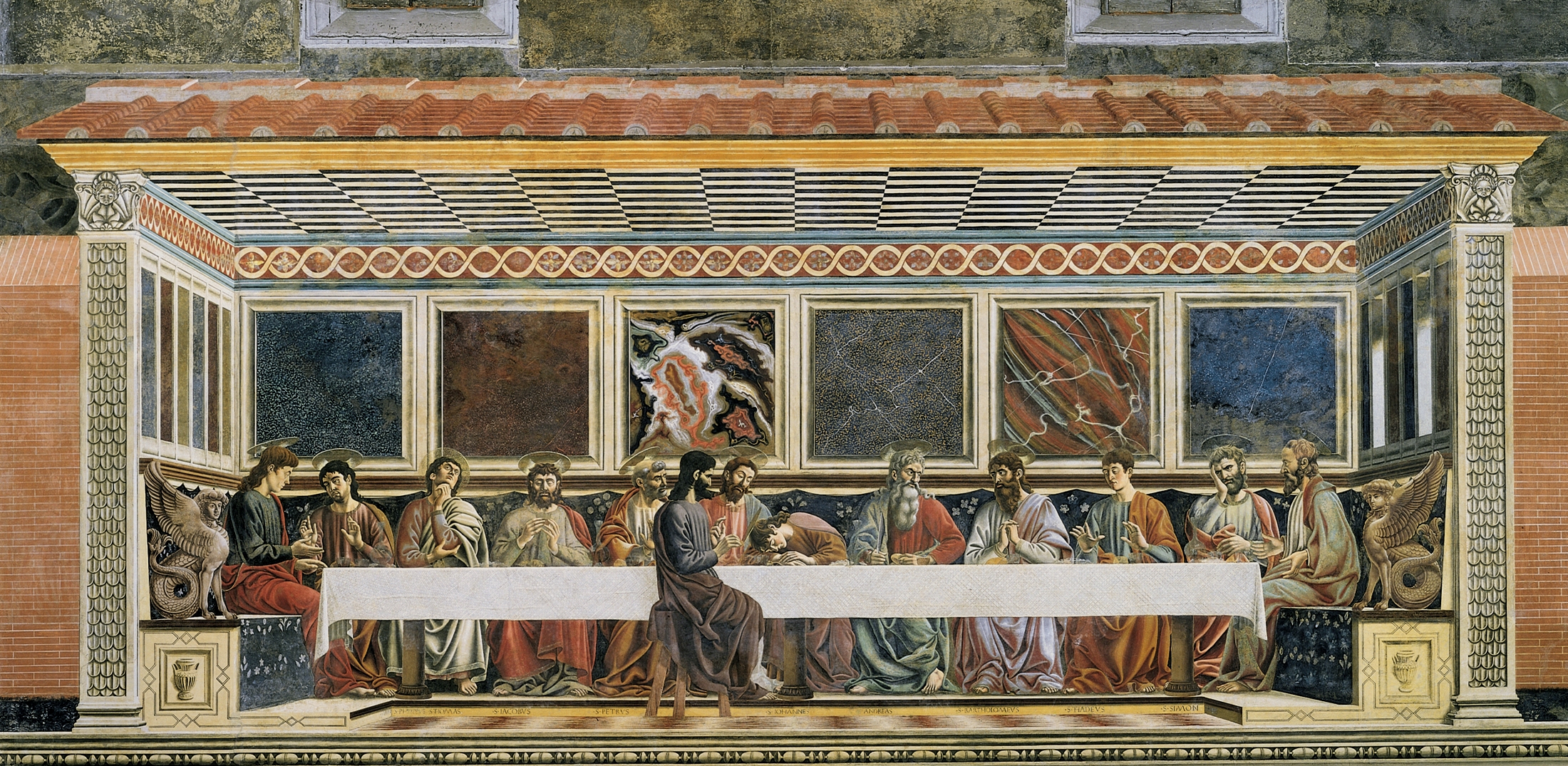
 Last Supper, Andrea Del Castagno, 1447. In the Cenacolo of Sant' Apollonia, Florence.
 Last Supper, Domenico del Ghirlandaio. 1480. In the Refrector, Ognissanti, Florence.
 All of three of these paintings came before da Vinci, all ascribe to a similar form, and all convey the gospel messages through similar means. We need to review the gospel story in general before we go on. These paintings depict the last supper of Jesus story found in the Synoptic Gospels of the New Testament. The story recounts Jesus' final meal with his twelve disciples, one of whom, Judas, would soon betray him for greed. Also notice how the apostle John is asleep atop the table. The major themes are all presented in the same way throughout each of these three paintings. And their message is effective; the depictions clearly present the story.
Most obviously, Judas, the betrayer, is sitting on the opposite side of the table as Jesus and the rest of the disciples, clearly setting him apart as different. Furthermore, Jesus and eleven of the disciples are painted with halos; Judas, meanwhile is bare-headed, indicating his sin. These messages are clear and well-portrayed. But they're also a bit blatant. Leonardo da Vinci changed all of this.
Last Supper, Leonardo da Vinci. 1495-1497. Refectory of the convent of Santa Maria delle Grazie, Milan.
 The differences between da Vinci's painting and that of his predessecors and contemporaries is stunning. Leonardo depicts the moment exactly as Jesus states that one of his apostles shall betray him. The apostles are all painted with extreme motion and emotion, each reacting heavily to Jesus' pronouncement. The extremity of facial expressions could have been drawn from Ghirlandaio's painting, as the History of Italian Renaissance Art notes. But unlike previous paintings, da Vinci places Judas on the same side of the table as the rest of the apostles.
But this does not mean we can't identify which apostle is Judas. Far from it, we can find Judas three figures to Jesus' right, covered in shadow, drawn back in horror, knowing and afraid of his guilt. With one hand, Judas grasps the money back given to him for his betrayal. With the other, he reaches for a loaf of bread, as written in the Gospel of Luke. Furthermore, the apostle John is no longer sleeping, and gone are the circlular halos. This I think is particularly apt point in regards to game design. Jesus is naturally haloed by the window behind him. The effect is a naturalistic, seamless one, not bogged down by the triteness of blatant circles.
All of these paintings are excellent. But da Vinci took the established standard and compltely surpassed it. Whereas before, symbolism, message, and theme were conveyed through obvious representations in the painting, e.g. Judas on our side of the table, visible haloes, da Vinci managed to present these exact same messages naturally: Judas in shadow and in shock, Jesus haloed by the window light.
 I think its clear what I'm getting at. Video games are moving fast towards a more seamless presentation of information. Look at the very recent Alone in the Dark, Far Cry 2, or Dead Space. All of these titles eschew the traditional HUD in favor of a more natural, realistic, in-world presentation. Alone in the Dark has an inventory system wherein players look at the pockets of their vest. Far Cry 2 keep players in-line with the vision of the character at all times: when he gets into cars, when he pulls shrapnel out of his body, etc. Dead Space displays information on Isaac's back or on the hologram in front of him, which is visually skewed as the camera is rotated, nor does the game wrest control from players. The upcoming Mirror's Edge places movement in the first-person-perspective like never before. Players can see, hear, and feel Faith's running limbs and wheezing breath. Are we now moving towards our own High Renaissance of Video Games? All of these games are doing amazing things, and as time goes on, as we enter the next-generation of video games only 2 or 3 years from now, the bar is certain to raise ever higher.
Sources:
History of Italian Renaissance Art: Painting, Sculpture, Architecture 6th Ed. by Frederick Hartt and David G. Wilkins. Published by Prentice Hall, 2007.
Andrea del Castango painting from Wikimedia.
Gaddi , Ghirlandaio, and da Vinci paintings from the Web Gallery of Art.
Dead Space image from Gamespot.
Leonardo da Vinci's presentation of message in his fresco of the Last Supper was highly innovative for its time; there is a reason the artist introduced the High Renaissance era of artwork. Whereas earlier paintings of the story employed contrived, blatant symbolism, da Vinci eschewed these methods for a more naturalistic, seamless conveyance of message.
Let's look at three earlier paintings, all of the Last Supper.
Last Supper, Tree of Life, and Four Miracle Scenes. Taddeo Gaddi, 1360. In the Refectory, Santa Croce, Florence
 Last Supper, Andrea Del Castagno, 1447. In the Cenacolo of Sant' Apollonia, Florence.
 Last Supper, Domenico del Ghirlandaio. 1480. In the Refrector, Ognissanti, Florence.
 All of three of these paintings came before da Vinci, all ascribe to a similar form, and all convey the gospel messages through similar means. We need to review the gospel story in general before we go on. These paintings depict the last supper of Jesus story found in the Synoptic Gospels of the New Testament. The story recounts Jesus' final meal with his twelve disciples, one of whom, Judas, would soon betray him for greed. Also notice how the apostle John is asleep atop the table. The major themes are all presented in the same way throughout each of these three paintings. And their message is effective; the depictions clearly present the story.
Most obviously, Judas, the betrayer, is sitting on the opposite side of the table as Jesus and the rest of the disciples, clearly setting him apart as different. Furthermore, Jesus and eleven of the disciples are painted with halos; Judas, meanwhile is bare-headed, indicating his sin. These messages are clear and well-portrayed. But they're also a bit blatant. Leonardo da Vinci changed all of this.
Last Supper, Leonardo da Vinci. 1495-1497. Refectory of the convent of Santa Maria delle Grazie, Milan.
 The differences between da Vinci's painting and that of his predessecors and contemporaries is stunning. Leonardo depicts the moment exactly as Jesus states that one of his apostles shall betray him. The apostles are all painted with extreme motion and emotion, each reacting heavily to Jesus' pronouncement. The extremity of facial expressions could have been drawn from Ghirlandaio's painting, as the History of Italian Renaissance Art notes. But unlike previous paintings, da Vinci places Judas on the same side of the table as the rest of the apostles.
But this does not mean we can't identify which apostle is Judas. Far from it, we can find Judas three figures to Jesus' right, covered in shadow, drawn back in horror, knowing and afraid of his guilt. With one hand, Judas grasps the money back given to him for his betrayal. With the other, he reaches for a loaf of bread, as written in the Gospel of Luke. Furthermore, the apostle John is no longer sleeping, and gone are the circlular halos. This I think is particularly apt point in regards to game design. Jesus is naturally haloed by the window behind him. The effect is a naturalistic, seamless one, not bogged down by the triteness of blatant circles.
All of these paintings are excellent. But da Vinci took the established standard and compltely surpassed it. Whereas before, symbolism, message, and theme were conveyed through obvious representations in the painting, e.g. Judas on our side of the table, visible haloes, da Vinci managed to present these exact same messages naturally: Judas in shadow and in shock, Jesus haloed by the window light.
 I think its clear what I'm getting at. Video games are moving fast towards a more seamless presentation of information. Look at the very recent Alone in the Dark, Far Cry 2, or Dead Space. All of these titles eschew the traditional HUD in favor of a more natural, realistic, in-world presentation. Alone in the Dark has an inventory system wherein players look at the pockets of their vest. Far Cry 2 keep players in-line with the vision of the character at all times: when he gets into cars, when he pulls shrapnel out of his body, etc. Dead Space displays information on Isaac's back or on the hologram in front of him, which is visually skewed as the camera is rotated, nor does the game wrest control from players. The upcoming Mirror's Edge places movement in the first-person-perspective like never before. Players can see, hear, and feel Faith's running limbs and wheezing breath. Are we now moving towards our own High Renaissance of Video Games? All of these games are doing amazing things, and as time goes on, as we enter the next-generation of video games only 2 or 3 years from now, the bar is certain to raise ever higher.
Sources:
History of Italian Renaissance Art: Painting, Sculpture, Architecture 6th Ed. by Frederick Hartt and David G. Wilkins. Published by Prentice Hall, 2007.
Andrea del Castango painting from Wikimedia.
Gaddi , Ghirlandaio, and da Vinci paintings from the Web Gallery of Art.
Dead Space image from Gamespot.
Subscribe to:
Posts (Atom)

 Posts
Posts